



Yes, it overflows, but not as automatic full coverage. GEO's overflow behaves more like a "one-way valve": rising from a narrow, sharp core intent up to broader intents is easy; descending from a generic intent down into specific business scenarios is hard.
* This is a mid-project review from Geolix.ai's work on a mini-program SaaS project for Jisu (即速应用). We use Jisu as a public case study, but we do not show the specific sources, article titles, URLs, or placement details; the focus is on the experimental method, the observed results, and a reusable GEO judgment framework.
Once companies begin working on GEO (Generative Engine Optimization), they quickly run into a practical question:
Do we have to buy and optimize every platform one by one: DeepSeek, Doubao (豆包), Yuanbao (元宝), Kimi, ChatGPT, and so on?
Behind that question are actually two distinct judgments:
- Cross-platform overflow: if we optimize content and sources around one platform, will other AI platforms start mentioning us too?
- Cross-phrasing overflow: if we only optimize for one specified query, will other phrasings under the same intent get pulled along?
We ran a reviewable GEO overflow experiment in a highly competitive mini-program SaaS project. Jisu is not the top-of-mind brand among users; its competitors include publicly listed companies as well as brands with very strong user awareness. Before the experiment began, Jisu was basically never proactively recommended by the models under the core intents; after selecting three intents and completing the first round of content optimization, Jisu began to be proactively recommended by the AI models under every one of those intents.
During the sampled phase, the proactive-recommendation rate for the target intents reached 100% in the first week of optimization; in subsequent continuous monitoring, the recommendation rate stabilized and fluctuated within the 30%–40% range.
But this article does not want to conclude that "optimizing one platform is enough," nor does it support the opposite conclusion that "all platforms must be bought at once." The more accurate conclusion is:
GEO does exhibit cross-platform and cross-phrasing intent overflow, but this overflow does not occur uniformly. It more easily rises from a specific question up to broader questions, yet it struggles to automatically descend into every fine-grained scenario.
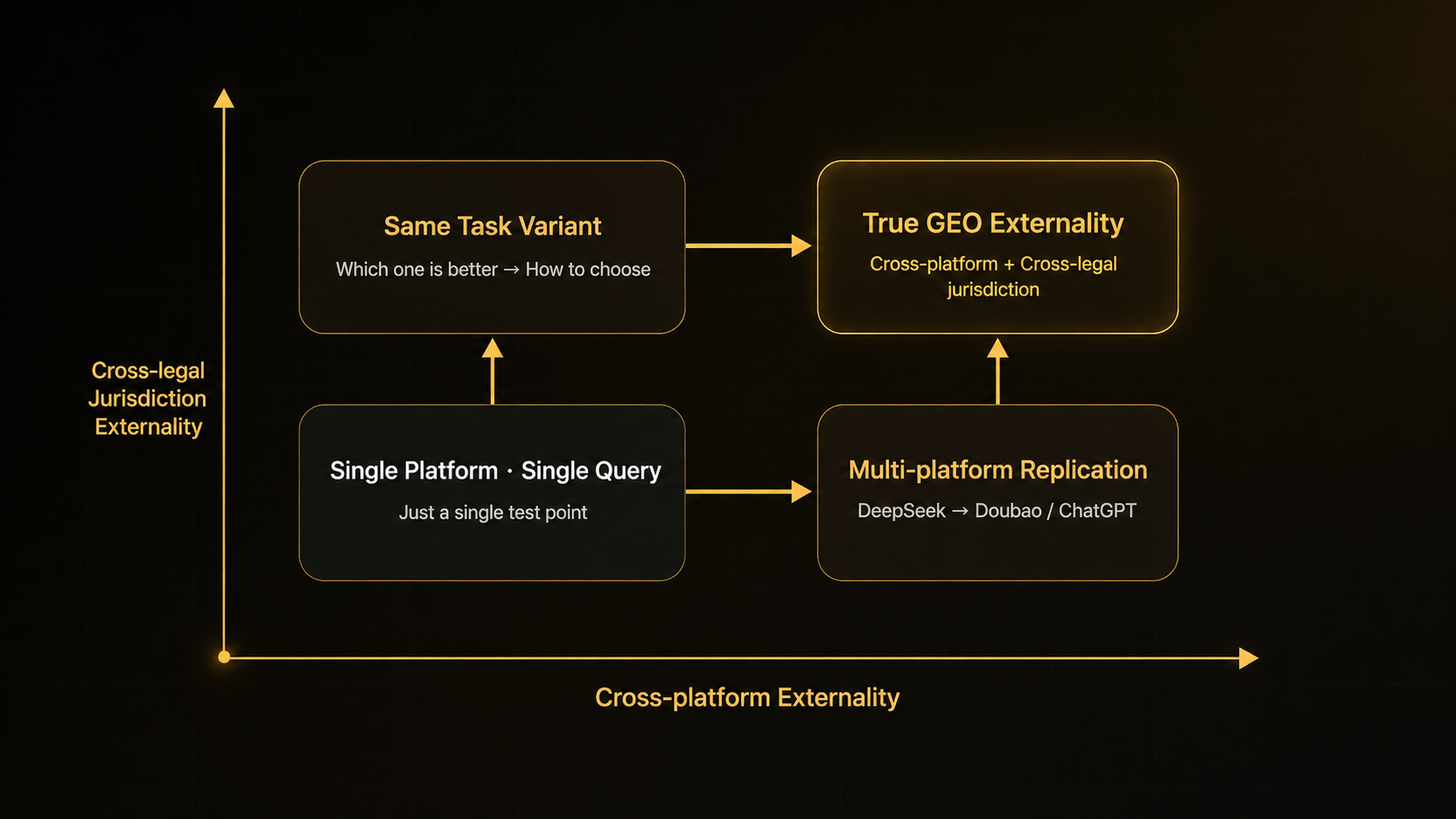
1. Why this question matters: what companies really want to know is not "how many articles to publish," but "where the money should go"
When a company asks "do we have to optimize for every platform," it is fundamentally not asking about the number of platforms, but about budget efficiency:
- If we do DeepSeek first, will our brand show up naturally on Doubao and ChatGPT?
- If we hit "which mini-program builder is best" first, will similar phrasings get pulled along too?
- If users ask more specifically, e.g. "local merchants building a mini-program," "what tool to use to open a shop and sell goods," "a private-domain membership mini-program", will the original content still cover them?
These three questions cannot be answered together.
If you only look at the first question, the answer is: there is a chance of overflow.
If you look at the second question, the answer is: phrasings on the same task chain have a chance of being pulled along.
But if you look at the third question, the answer requires far more caution: specific scenarios are usually not automatically covered, especially when that scenario already has a stronger default brand or more fitting content.
This is the core judgment of this article:
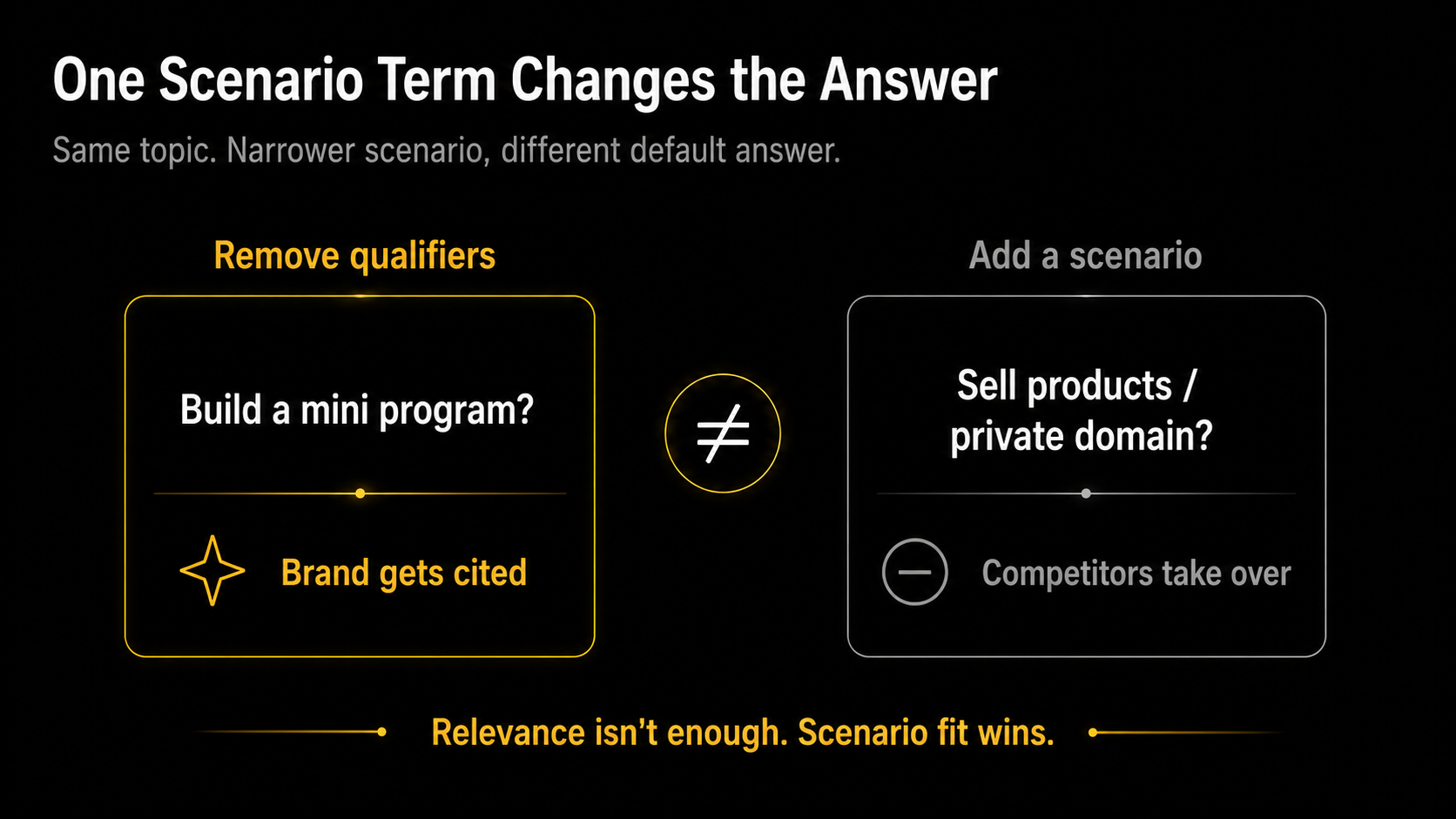
GEO is not simply a matter of "if it's relevant, it gets recommended"; relevance has a direction. Remove the qualifiers and the model may generalize on your behalf; add a specific scenario and the brand must claim that position itself.
2. Experiment background: mini-program building is an industry with very strong incumbent brands
Jisu's industry is mini-program building / mini-program SaaS.
Judging by how users ask questions, this kind of industry is naturally well-suited to AI search:
- "Which mini-program builder platform is best?"
- "What mini-program builder platforms are there?"
- "What tool should I use to build a mini-program?"
- "How do I choose a mini-program building company?"
- "Which platform should a local merchant use to build a mini-program?"
- "I want to open a shop and sell goods, what mini-program tool should I use?"
- "With no tech team, how can I quickly build a mini-program?"
These questions look similar, but to a model they are not entirely the same.
"Which platform is best" is usually a recommendation-style selection question; "what platforms are there" is more of a candidate-list question; "how should a local merchant choose" starts layering in an industry scenario; "open a shop and sell goods / build a private domain" has already switched to the business-goal layer.
From a competitive standpoint, this industry is not easy either. In traditional search and AI answers, users easily encounter brands or solutions like Youzan (有赞), Weimob (微盟), Fkw (凡科), Qiaotuoyun (乔拓云), WeChat Developer Tools, and Taro. Some competitors are themselves publicly listed companies or large brands that have long dominated mindshare in the industry.
Jisu is not the top-of-mind brand among users. In other words, this is not a case of "the brand was already strong, so the AI recommended it as a matter of course." It is a more typical GEO problem:
When Jisu is not the biggest brand, can intent selection, content structure, and source placement get the model to proactively recommend it under specific questions?
3. We chose three intents, but did not spread our effort evenly
This round of the project first locked in three core intents. This article publicly expands on two of them; the third intent involves project pacing and commercial information, so it is not detailed here.
We did not write the content as single-brand promotion; instead, we placed the brand inside the "comparison framework that users actually ask about." Because when a user asks "which is best," the AI usually does not want just one brand name; it tends to generate a comparison answer: who suits small and medium merchants, who suits chain stores, who suits ad placement, who suits custom development, who suits low-cost rapid launch.
Only by entering this comparison structure does a brand become more likely to be part of the model's answer.
Intent 1: which mini-program builder platform is best
This intent is closer to "recommendation-style selection." The user already knows they need a mini-program platform; the next step is to judge among several platforms.
Around this intent, what we did was "multi-angle source placement," but the body here does not show the specific sources, article titles, or URLs. Here we retain the reusable content structure:
| Content angle | Function |
|---|---|
| Industry trends + platform selection | Place Jisu into the "mini-program builder platform" candidate set |
| Local-merchant digitalization | Catch the adjacent scenario of "how should a local merchant choose" |
| Cross-comparison reviews of SaaS tools | Give the model comparison dimensions such as features, cost, and target audience |
| Selection-pitfall / experience-based content | Reduce the ad feel and add real decision-making context |
Intent 2: which mini-program builder platforms are available
This intent is closer to "list-style awareness." The user may not decide immediately, but is building a candidate list. For GEO, this kind of intent matters, because once a model includes a brand in its candidate set, later recommendation-style questions are more likely to keep mentioning it.
Around this intent, the content focus shifts from "recommend one specific brand" to "help the model build a candidate list." Again we do not show the specific sources, article titles, or URLs, only the content strategy:
| Content angle | Function |
|---|---|
| Tool-list content | Help the model build a candidate-platform set |
| In-depth review content | Put Jisu into the same comparison framework as the leading competitors |
| Research / decision-record content | Provide more natural selection language that's easy for the model to paraphrase |
These two kinds of intent are not a simple keyword difference; they are different positions on the user's decision chain:
| Intent | User's stage | GEO value |
|---|---|---|
| What mini-program builder platforms are there | Building a candidate list | Get the brand into the model's "candidate set" first |
| Which mini-program builder platform is best | Comparing and deciding | Get the brand recommended, with a stated reason |
| Scenario phrasings like local merchant / open a shop to sell / private domain | Specific business execution | Needs to claim position separately; cannot rely on a generic article to cover it naturally |
4. Experiment observation 1: Jisu went from "invisible" to entering the model's candidate set
Before the experiment, Jisu's performance under the target intents was close to "invisible":
- The model did not proactively mention Jisu in its answers;
- In comparison-style answers, Jisu did not make the candidate list;
- In related questions, leading competitors more easily took the recommended slots.
After the first round of optimization, all three selected intents showed clear changes: the model began proactively recommending Jisu in relevant answers, and placed Jisu into comparison tables, candidate lists, or use-case suggestions.
Internally, we defined "proactive recommendation" as:
| Type | Counts as proactive recommendation? |
|---|---|
| The model directly recommends Jisu | Counts |
| The model lists Jisu in a candidate-platform set / comparison table | Counts |
| The model cites or paraphrases Jisu's advantages from the article | Counts |
| The webpage is retrieved, but Jisu does not appear in the answer | Does not count |
| Jisu only appears after the user explicitly asks for the brand name | Not counted in the core recommendation rate |
By this standard, the target intents reached a 100% proactive-recommendation rate in the first week of optimization. Afterward, as model answers fluctuated, sources updated, and competitor content changed, the recommendation rate fell back and stabilized at 30%–40%.
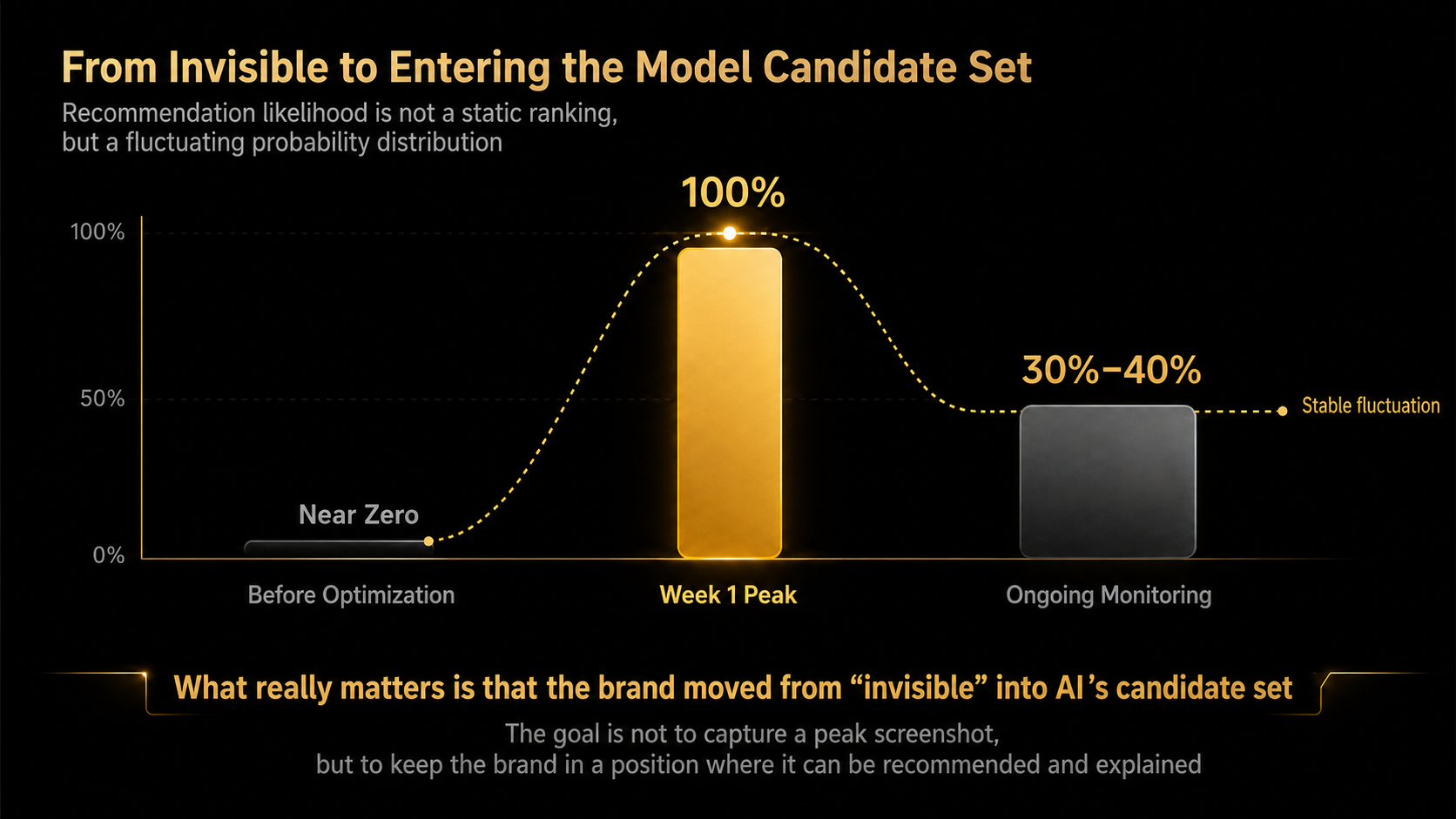
This result is actually closer to real GEO: AI recommendation is not a static ranking, but a continuously fluctuating probability distribution.
So we care more about two things:
- Whether Jisu went from "invisible" to entering the model's candidate set;
- Whether the recommendation rate can remain within an explainable, optimizable range in subsequent monitoring.
For a challenger brand like Jisu, "entering the candidate set" is itself an important change. Because many AI answers do not give just one answer, they give 3–6 candidate platforms and explain who each suits. As long as the brand can maintain a stable position in this candidate set, it has a chance to keep being cited, compared, and recommended in later Q&A.
5. Experiment observation 2: optimizing DeepSeek really does overflow to Doubao and ChatGPT
Many companies ask: if we optimize for DeepSeek first, do we still need to do Doubao, ChatGPT, Kimi, and Yuanbao separately?
To answer this, we did a cross-platform observation of the same question: after optimizing content and sources around DeepSeek's target question, we then observed how Doubao and ChatGPT changed their answers to similar questions.
The result is: cross-platform overflow exists.
On some target questions, although the optimization actions first centered on DeepSeek, Doubao and ChatGPT also began including Jisu in their recommendation or comparison range. This shows that although different models have their own retrieval sources, ranking preferences, and generation habits, they are all influenced by public sources, content structure, and industry consensus.
That said, overflow is not "copy-paste."
The differences we observed include:
- DeepSeek is more easily influenced by recent Chinese-language web pages and structured review content;
- Doubao has fairly broad coverage of Chinese content, but has its own preferences for brand ranking and scenario matching in its answers;
- ChatGPT, in connected (web-browsing) scenarios, places more emphasis on source explainability and may not fully follow the ranking of Chinese platforms;
- The same piece of content may show up in different models as "cited," "paraphrased," "listed as a candidate," or "not appearing at all."
So the reasonable understanding of cross-platform overflow is not "do one platform and the others are automatically fully covered," but:
Once content enters the public source layer that models can access, understand, and paraphrase, it has a chance to be absorbed jointly by multiple models.
This is also why we do not recommend mechanically buying the same set of services repeatedly for every platform at the very start of a project. A more effective path is usually: first solidify the core intents and core sources, then judge, based on monitoring results, which platforms need separate reinforcement.
6. Experiment observation 3: under the same intent, non-targeted queries get pulled along, but with a directional limit
The second experimental question is: if we specify optimization for "which mini-program builder platform is best," will similar but not identical phrasings get pulled along?
For example:
- "How to choose a mini-program builder platform in 2026?"
- "What mini-program platforms are suitable for small and medium merchants?"
- "Which platform should a local merchant use to build a mini-program?"
- "How do I build a mini-program with no tech team?"
- "Any recommended mini-program SaaS platforms?"
The observation is: same-intent variants do indeed get pulled along, but not all variants are pulled along equally.
This is also the point most worth emphasizing in this review:
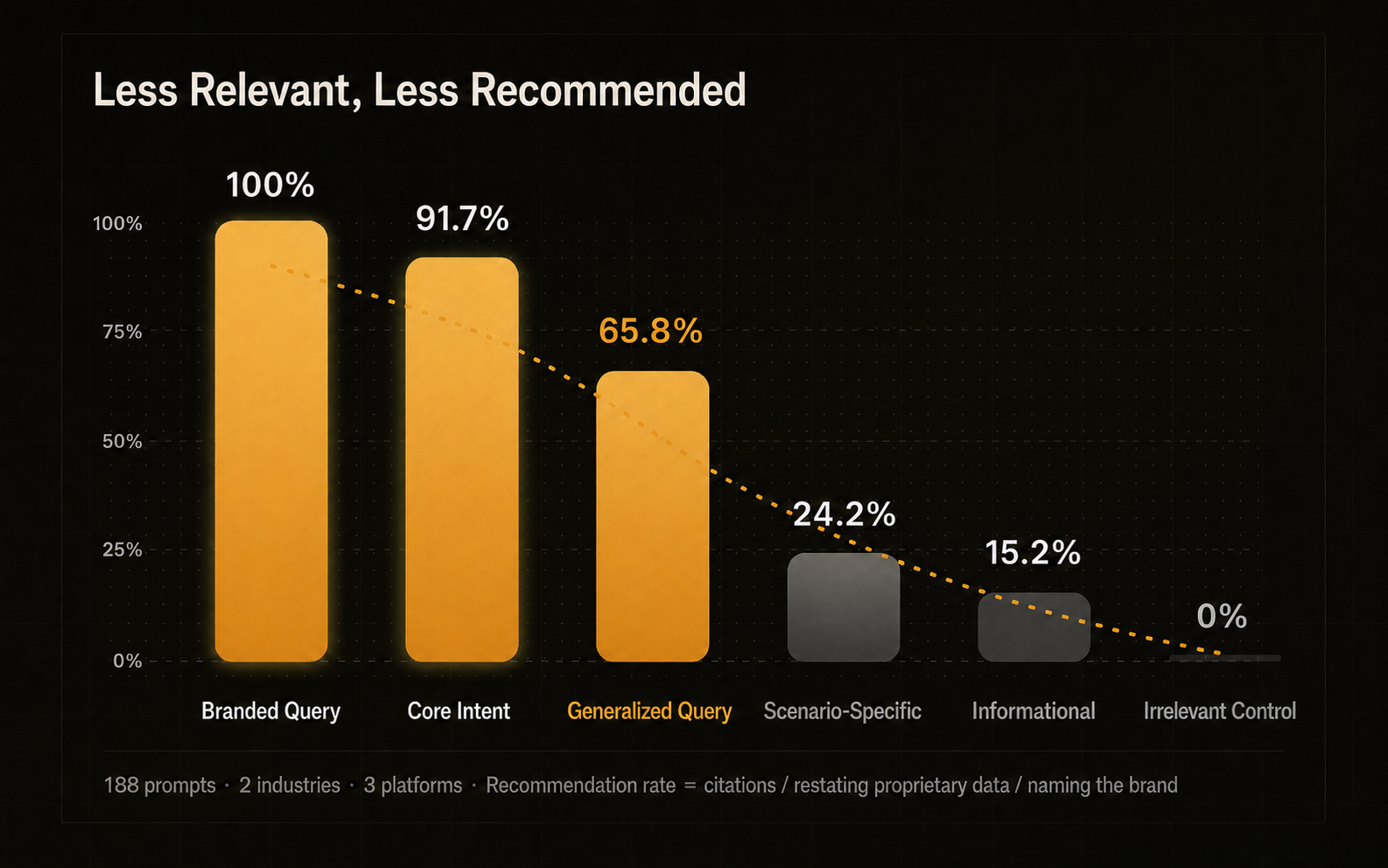
Intent overflow is not bidirectional; it is a one-way valve where "rising is easy, descending is hard."
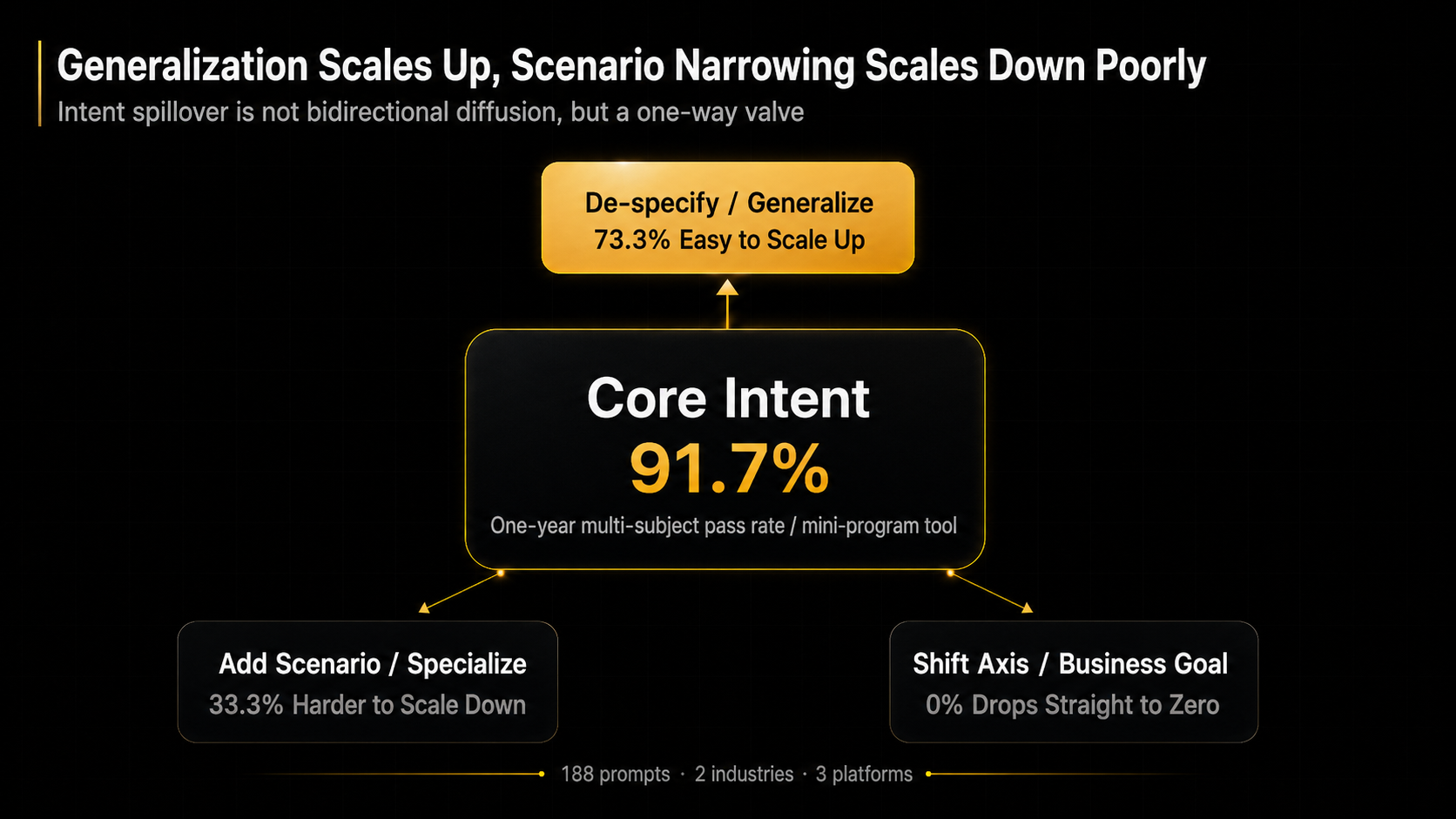
In other words, if a piece of content is written clearly enough around one narrow, sharp core intent, such as "which mini-program builder platform is best" or "what tool to use to build a mini-program," it has a chance of being taken by the AI to answer broader questions, because the specific comparison dimensions can serve as evidence for the broader question.
But the reverse does not hold. Once a user adds more specific scenario words, like "local merchant," "no tech team," "open a shop and sell goods," "private-domain membership," and "chain stores," the AI will often not automatically apply the generic content to these narrower scenarios; instead it looks for content or a brand that fits that scenario more closely.
You can break phrasings into the following layers:
| Phrasing direction | Typical question | Easily pulled along? | Judgment |
|---|---|---|---|
| Category core intent | "Which mini-program builder platform is best?" | Most easily | This is the main battlefield; you must claim it head-on |
| De-qualified / generalized | "What tool to use to build a mini-program?" | Fairly easily | The model treats the specific content as evidence for the broad question |
| Same-task variant | "How to choose a mini-program platform in 2026?" | Fairly easily | Provided the content covers the selection dimensions |
| Add scenario / specialize | "Which platform should a local merchant use to build a mini-program?" | Unstable | The more specific the scenario, the more it needs separate content to catch it |
| Switch business goal | "What tool to use to open a shop and sell / build a private domain?" | Very hard to cover automatically | The model may prioritize the default strong brand for that goal |
So it is not enough for an article to be merely "relevant." What the AI actually takes to generate an answer is content that helps it complete a judgment:
- Who it is suitable for;
- Who it is not suitable for;
- Where the feature boundaries are;
- What the price and deployment cost are;
- What the differences are versus competitors;
- Whether there are paraphrasable data points;
- Whether there is a clear scenario conclusion.
An article that only states a stance is unlikely to become the basis of an answer; an article that helps the model complete a judgment is more likely to be cited, paraphrased, and recommended.
7. Why does this overflow happen?
From this experiment, GEO overflow roughly comes from three layers of mechanism.
1. Platforms share a portion of public sources
Different AI platforms' underlying retrieval, ranking, and generation logic are not identical, but they are all influenced by public web pages, media content, structured reviews, industry discussion, and verifiable information.
When a brand repeatedly appears in multiple trustworthy sources within the same category, the same use case, and the same comparison framework, the model more easily forms a judgment:
This brand really does belong to the answer set "mini-program builder platforms."
This is also the basis of cross-platform overflow.
2. The model understands user tasks, not keywords
Traditional SEO easily puts the emphasis on keywords, for example, "which is best" and "what are there" are two phrases. But in AI search, the model cares more about the user's task:
- Is the user trying to build a candidate list?
- Is the user trying to make a final decision?
- Is the user trying to compare prices?
- Is the user trying to judge whether it fits their own business?
If the content can cover the same task chain, it can overflow from one phrasing to another.
For example, "which mini-program builder platforms are available" helps the model build a candidate list; "which mini-program builder platform is best" helps the model complete a comparative recommendation. Both are on the same selection chain, so there is a possibility of mutual spillover.
3. A paraphrasable structure matters more than mere exposure
When an AI model generates an answer, what it needs is not just "the brand appeared on a webpage," but information that can be organized into the answer.
For example:
- "Suitable for small teams of 1–10 people";
- "Showcase, online store, and private domain share one back end";
- "Supports multi-platform publishing";
- "Suitable for local merchants who want a low-cost rapid launch";
- "Different use cases from platforms like Youzan, Weimob, and Fkw."
This kind of information is naturally suited for inclusion in the AI's stated reasons for recommendation, so it is more easily absorbed by the model than generic brand exposure.
4. The more specific the scenario, the more the model needs an "on-point answer"
The reason overflow has a one-way valve is that "broad questions" and "specific-scenario questions" impose different requirements on the answer.
Broad questions usually need a candidate set and generic comparison dimensions, and the core article can provide this material; but specific-scenario questions often need clearer scenario evidence.
For example:
- "Local merchant building a mini-program" needs to explain storefront display, booking, in-store redemption, and member accumulation;
- "Open a shop and sell goods with a mini-program" needs to explain product management, payment, orders, distribution, and marketing plugins;
- "Build a private-domain membership mini-program" needs to explain member tags, outreach, points, and repurchase;
- "Chain stores building a mini-program" needs to explain multi-store, multi-role permissions, and data aggregation;
- "Build a mini-program with no tech team" needs to explain templates, low-code, delivery timeline, and maintenance cost.
If the generic article does not answer these scenarios head-on, the AI easily turns to a competitor or an existing strong brand that fits the scenario more closely.
8. This does not mean "you don't need to optimize for any of the platforms"
The conclusion this experiment gives us is not "optimizing for DeepSeek alone is enough," but a more granular placement judgment:
We do not recommend spreading efforts evenly across all platforms from the start without monitoring evidence; nor do we recommend looking at one platform's result and assuming all other platforms will be covered naturally.
A more robust GEO strategy can be split into four steps.
Step 1: First pick a "narrow and sharp" core intent
Don't try to grab the broadest keyword from the start. Broad big keywords are often already occupied by leading brands, encyclopedia content, tool lists, and platforms' official information.
A more effective approach is to first choose a core intent with high commercial value, clear question boundaries, and real brand differentiation.
For mini-program SaaS, "which mini-program builder platform is best" and "which mini-program builder platforms are available" are two entry points of different value:
- The former is closer to a decision;
- The latter is closer to a candidate list;
- Both can influence the model's judgment of the category the brand belongs to.
Step 2: Use content structure to help the model complete a judgment
Don't just write "Jisu is great"; create answer material that the model can paraphrase.
A piece of GEO content that's more easily absorbed by AI usually needs to contain these modules:
| Module | Function |
|---|---|
| Cross comparison | Get the brand into the candidate set |
| Use cases | Let the model know when to recommend you |
| Not-suitable boundaries | Raise answer credibility and avoid a pure-ad feel |
| Competitor differences | Give the model ranking and recommendation reasons |
| Paraphrasable data | Let the content become evidence inside the AI answer |
| Conclusion table | Make it easy for the model to extract and generate a structured answer |
Step 3: Break through the key platforms first, then observe natural overflow
Don't thin out the budget across all platforms from the start. First validate on one or two key platforms:
- Whether the content can be retrieved;
- Whether the content can be understood;
- Whether the brand can enter the candidate set;
- Whether the recommendation reasons paraphrase the selling points we designed;
- Whether natural overflow appears on other platforms.
If the brand isn't being recommended even for the core phrasings, expanding platforms directly is usually just scaling up ineffective effort.
Step 4: Give high-value scenarios their own dedicated articles
This is the biggest strategic change the "one-way valve" conclusion brings.
In the past, many companies stuffed all their selling points into one generic article, hoping it would cover all questions. But judging by GEO's actual performance, this approach is not stable.
A more reasonable way is: first use the core article to break through the category intent, then write dedicated, head-on articles around high-value scenarios.
| Scenario sub-intent | Suggested content direction | Goal |
|---|---|---|
| Local merchant building a mini-program | Local storefront digitalization, mini-program selection, low-cost launch | Capture the "local merchant" scenario |
| Using a mini-program to open a shop and sell goods | Comparison of product, order, payment, marketing, and distribution capabilities | Capture the "selling goods" scenario |
| Building a private-domain membership mini-program | Membership, points, repurchase, customer accumulation | Capture the "private domain" scenario |
| Chain-store mini-program | Multi-store, permissions, data, headquarters management | Capture the "chain" scenario |
| Building a mini-program with no tech team | Templates, low-code, delivery timeline, maintenance cost | Capture the "no tech team" scenario |
In one sentence: the core article handles rising; the scenario articles handle descending.
9. Takeaways for companies doing GEO
This mini-program SaaS case offers several reusable takeaways.
First, GEO is not just "publishing articles"; it is content engineering built around the structure of the model's answer. An article must enter the model's recommendation logic, not merely appear on a webpage.
Second, intent matters more than keywords. The same keyword may correspond to different user tasks; the same user task may be expressed by many different phrasings. When optimizing, design content around "what judgment does the user actually want the AI to help them make."
Third, cross-platform overflow exists, but should not be mythologized. Different models share part of the public sources and also have their own citation preferences. Using monitoring data to judge platform priority is more objective than rolling out all platforms at once.
Fourth, cross-phrasing overflow exists, but the direction is asymmetric. Reduce the qualifiers and the model may generalize on the brand's behalf; add scenario words and the brand must claim the position itself. Don't expect a single generic article to automatically cover every fine-grained scenario.
Fifth, the proactive-recommendation rate is a dynamic metric. Reaching 100% in the first week is valuable, but holding steady at 30%–40% over the long term is equally worth watching. Because AI answers fluctuate with retrieval, context, time, and competitor content, the goal of GEO is not to capture a peak screenshot, but to keep the brand continuously in the model's candidate set.
Conclusion: GEO overflow is real, but it must be designed and monitored
In this Jisu mini-program SaaS project, we saw a fairly clear result:
- Jisu went from 0 visibility under the target intents to proactive recommendation by the models;
- All three selected intents produced recommendation results;
- In the first week of optimization, the target intents' proactive-recommendation rate reached 100%;
- The recommendation rate subsequently stabilized at 30%–40%;
- Optimization targeting DeepSeek overflowed to Doubao and ChatGPT;
- Optimization of a specified query also pulled along some variant phrasings on the same task chain.
But what matters more than the numbers themselves is the evaluation framework behind them:
The core of GEO is not buying every platform once or expecting one article to cover all scenarios; it is first understanding the relationship between user intent, the structure of the model's answer, public sources, and the direction of overflow.
Once these relationships are seen clearly, a company can decide more rationally:
- Which platforms must be optimized specifically;
- Which platforms can be observed for natural overflow;
- Which core intents are worth doubling down on;
- Which scenario sub-intents must get their own dedicated articles;
- Which phrasings are just noise and not worth investing in.
This is also what Geolix.ai cares more about when running GEO projects: not manufacturing a one-off impression, but making the brand a continuously recommendable, explainable, and trustworthy answer in real AI-assisted decision-making scenarios.